


Chinese President Xi Jinping (習近平) on Thursday declared victory in an eight-year drive to eradicate extreme poverty in the world’s most populous nation, a key goal of the ruling Chinese Communist Party (CCP).
“We have achieved in a timely manner the poverty alleviation goal of the new era,” Xi said at a meeting of the seven-member Politburo Standing Committee, China’s supreme decisionmaking body, the official Xinhua news agency reported.
The incomes of nearly 100 million people had moved above China’s official poverty line — defined as those who earn less than 11 yuan (US$1.68) per day, he said.

Photo: Bloomberg
After assuming leadership of the CCP eight years ago, Xi made the drive to eliminate extreme poverty by this year one of his top goals.
The party defines it as a step toward achieving what it calls a “moderately prosperous” society, a key part of its moves to improve living standards and underpin its claim to political legitimacy.
The anti-poverty campaign has been focused on rural areas which largely escaped COVID-19 transmission in China this year.
Tens of millions of migrant workers from the countryside were estimated to have lost their jobs due to the closure of factories in the first quarter of the year when China implemented nationwide lockdowns. Gauges of employment have largely recovered since then.
“The declaration tells us more about how the Chinese government defines poverty than about actual levels of deprivation and substantive improvements in people’s lives,” said Sarah Rogers, a lecturer in contemporary China studies at the University of Melbourne who has studied the anti-poverty campaign. “I’m not convinced the campaign has addressed the underlying drivers of deprivation, disempowerment and stark inequality in China”
Earlier this year, Chinese Premier Li Keqiang’s (李克強) set off a nationwide debate on poverty alleviation when he reminded the public that two-fifths of China’s population earned just 1,000 yuan per month on average.
“It’s not even enough to rent a room in a medium-sized Chinese city,” he said during the annual national parliament meeting in May.
The anti-poverty campaign has involved a massive mobilization of state resources, with tens of millions of people relocated from remote villages to newly built homes closer to urban centers.
Elderly and disabled rural residents have received cash handouts and the government has launched schemes to find jobs for the unemployed or those dependent on subsistence farming.
Xi described the achievement, which was given top-billing in state media yesterday, as the result of the “largest and most vigorous battle in human history against poverty.”
China’s poverty line is slightly below the absolute poverty level of the World Bank, at market exchange rates.
China last month removed the final nine counties, all in the mountainous Guizhou Province, from a national list of impoverished counties, Xinhua reported last month.
The average income in those counties had reached 11,487 yuan per year, it said.

Four contenders are squaring up to succeed Antonio Guterres as secretary-general of the UN, which faces unprecedented global instability, wars and its own crushing budget crisis. Chile’s Michelle Bachelet, Argentina’s Rafael Grossi, Costa Rica’s Rebeca Grynspan and Senegal’s Macky Sall are each to face grillings by 193 member states and non-governmental organizations for three hours today and tomorrow. It is only the second time the UN has held a public question-and-answer, a format created in 2016 to boost transparency. Ultimately the five permanent members of the UN’s top body, the Security Council, hold the power, wielding vetoes over who leads the

A humanoid robot that won a half-marathon race for robots in Beijing on Sunday ran faster than the human world record in a show of China’s technological leaps. The winner from Honor, a Chinese smartphone maker, completed the 21km race in 50 minutes and 26 seconds, said a WeChat post by the Beijing Economic-Technological Development Area, also known as Beijing E-Town, where the race began. That was faster than the human world record holder, Ugandan Jacob Kiplimo, who finished the same distance in about 57 minutes in March at the Lisbon road race. The performance by the robot marked a significant step forward

An earthquake registering a preliminary magnitude of 7.7 off northern Japan on Monday prompted a short-lived tsunami alert and the advisory of a higher risk of a possible mega-quake for coastal areas there. The Cabinet Office and the Japan Meteorological Agency said there was a 1% chance for a mega-quake, compared to a 0.1% chance during normal times, in the next week or so following the powerful quake near the Chishima and Japan trenches. Officials said the advisory was not a quake prediction but urged residents in 182 towns along the northeastern coasts to raise their preparedness while continuing their daily lives. Prime
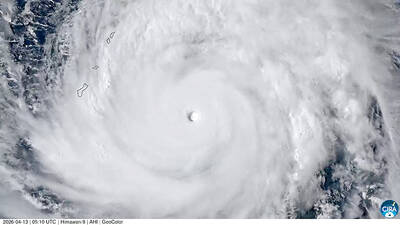
HAZARDOUS CONDITION: The typhoon’s sheer size, with winds extending 443km from its center, slowed down the ability of responders to help communities, an official said The US Coast Guard was searching for six people after losing contact with their disabled boat off the coast of Guam following Typhoon Sinlaku. The crew of the 44m dry cargo vessel, the US-registered Mariana, on Wednesday notified the coast guard that the boat had lost its starboard engine and needed assistance, Petty Officer 3rd Class Avery Tibbets said yesterday. The coast guard set up a one-hour communication schedule with the vessel, but lost contact on Thursday. A Coast Guard HC-130 Hercules aircraft was launched to search for the six people on board, but it had to return to Guam because of


 RSS
RSS